Real World Atlas
Research note // 002
Category
Physical computing /
Real-world orchestration /
Physical AI /
Robotics infrastructure
Status
Frontier thesis
Research origin
Milan, Italy
45.4642° N, 9.1900° E
Bits became programmable.
What if atoms do too?
If atomsbecome bits,what becomesthe operating system?
Software made information programmable. Physical AI is beginning to make the physical world programmable.
But programmability creates another question.
Who turns human intent
into instructions
for the physical world?
The atoms computer
Their thesis // source-derived
In July 2026, Atoms announced a $1.7B equity investment led by a16z, merging Travis Kalanick's businesses into a single structure and describing the work as completing a bits-to-atoms arc that began at Uber and continued at CloudKitchens. Kalanick's own framing is direct: digitizing the physical world is his life's work.
The investor thesis is stated in the same terms. Computers took over the world of bits — transforming information, sending information, storing information — and the ambition behind Atoms is to do the equivalent for physical matter: food, mining, transport, manufacturing, storage, movement.
Sources filed below // 05 primary and reported items
Digital computer
CPU
→ Manipulates bits
Storage
→ Stores bits
Network
→ Moves bits
Physical computer
Manufacturing
→ Manipulates atoms
Real estate / physical infrastructure
→ Stores atoms
Transport / logistics
→ Moves atoms
Bits
Weightless. Instantaneous.
Copyable. Reversible.
Atoms
Mass. Distance. Energy.
Friction. Time. Consequence.
// Archive signal 002
Treat atoms like bits.
Atlas compression of the published thesis. Not a quotation, not attributed to any individual.
The physical computer
If manufacturing becomes programmable, transport becomes autonomous, warehouses become robotic, machines become intelligent and physical infrastructure becomes software-controlled, then the physical world starts to behave less like a market and more like a computational environment: addressable resources, contended capacity, latency, failure.
Resource ledger // conceptual
Robotic arm
Executor // machine
Physical resource // available
Autonomous vehicle
Executor // machine
Location // physical
Warehouse robot
Executor // machine
State // dynamic
Humanoid
Executor // machine
Physical resource // available
Manufacturing cell
Executor // industrial
State // dynamic
Human provider
Executor // human
Physical resource // available
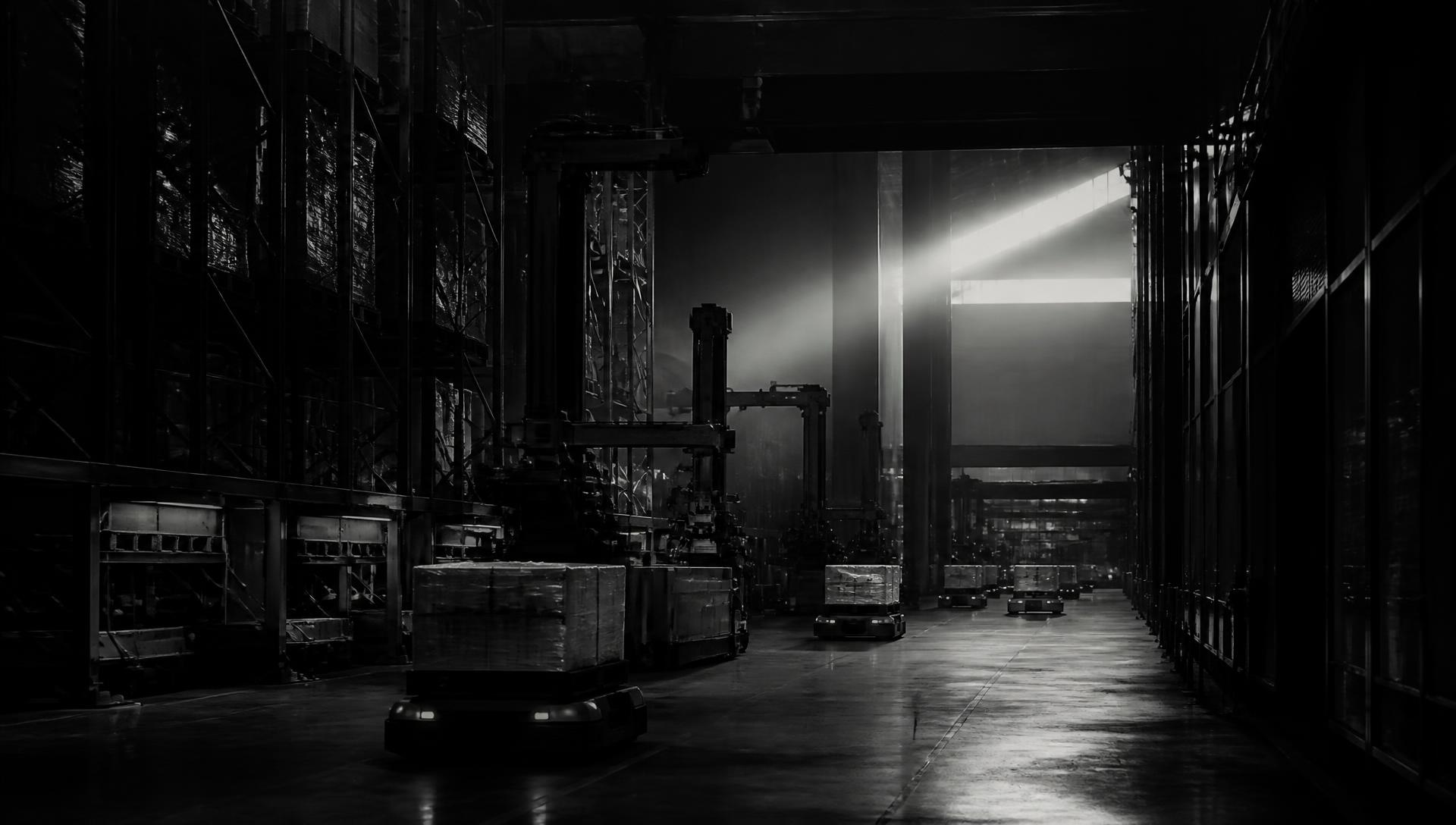
The physical world is becoming computable.
Computable
does not mean coordinated.
Automated logistics // illustrative reference, third-party hardware
Programmability is not intent
Making atoms programmable
is one problem.
Connecting that programmability
to human intent is another.
Autonomous vehicle
can move.
Robotic arm
can manipulate.
Humanoid
can act.
Factory
can manufacture.
Warehouse
can store.
Delivery robot
can transport.
But none of these capabilities automatically know what outcome a human wants — or which of them should be the one to produce it.
Real World Atlas · Research note 002
The missing abstraction
The digital world
built abstractions
above hardware.
Digital stack
Human
Application
Operating system
Compute
Hardware
Physical stack
Human intent
?
Physical compute
ManufacturingTransportStorageHuman providersAutonomous machinesRobotsPhysical outcome
What sits here?
The physical world
may need an intent layer.
Stated as an Atlas hypothesis. Not an established industry category, and not a claim that such a layer exists in general form today.
Uber was a clue
Set the company history aside; the interesting artifact is the abstraction. A rider expressed an outcome, and software allocated physical resources until that outcome existed.
Human intent
Take me from here to there.
Resolution path
Outcome // verified
Our read //
Uber can be interpreted as an early, extremely narrow intent-to-physical-world system. Its dominant intent was almost trivially simple: move me.
The user never needed to understand dispatch systems, driver availability, routing, pricing infrastructure, payment infrastructure or vehicle coordination. They expressed an outcome; software orchestrated the physical resources required to produce it.
What happens
when the number
of intents explodes?
From one intent to thousands
Intent signals
Take me to the airport.
Get dinner home.
Send flowers.
Move this package.
Prepare the house.
Buy groceries.
Book a physical service.
Get my parents home.
Charge the car.
Deliver this object.
Orchestration layer
Executors
- HumanDormant
- ProviderDormant
- APIDormant
- Autonomous vehicleActive
- Delivery robotDormant
- Robotic armActive
- HumanoidDormant
The physical scheduler
A computer must allocate scarce resources under contention. The physical world has scarce resources too — and unlike a thread pool, they occupy space, consume energy and arrive late.
- 01
Which vehicle?
- 02
Which robot?
- 03
Which human?
- 04
Which provider?
- 05
Which location?
- 06
Which time window?
- 07
Which budget?
- 08
Which route?
- 09
Which machine?
- 10
Which task first?
- 11
What if something fails?
Real-world orchestration
starts to look less like a chatbot
and more like a scheduler
for physical resources.
Resource states // conceptual, not a dashboard
Autonomous vehicle 07
Available
Executing
Rerouted
Verified
Delivery robot 12
Waiting
Executing
Failed
Rerouted
Human provider 03
Available
Busy
Executing
Verified
Robotic arm 21
Available
Executing
Verified
Manufacturing cell B
Busy
Executing
Waiting
Verified
Humanoid 02
Available
Waiting
Executing
Failed
Atoms have consequences
Bits
Copy
Retry
Rollback
Regenerate
Duplicate
Atoms
Move
Consume
Break
Collide
Arrive
Fail
Cost
Take time
A bit can be copied.
A car cannot be in two places at once.
A response can be regenerated.
A broken object cannot always be rolled back.
A software request can time out.
A human can be left waiting at the airport.
Consequence is what turns three soft words into infrastructure requirements: permission before the action, recovery during it, verification after it.
Continues from research note 001
Who gives AI permission to act in the real world?
Read note 001 →And once it acts —
what happens when reality
doesn't cooperate?
The intent-to-atoms stack
Human intent
What outcome is wanted
Context
Where, when, for whom
Authority
What is permitted
AI decision
What should happen
Real-world orchestration
How it gets sequenced
Resource allocation
Scarce physical capacity
Executor selection
Who or what performs it
HumanProviderAPIAutonomous machineRobotPhysical action
Matter changes state
Verification
Did it actually happen
Outcome
Confirmed change in the world
Intent becomes
a change
in the physical world.
Intent → atoms
Our read
// Real World Atlas — interpretation, not sourced findingThe atoms-as-bits framework asks what happens when physical infrastructure becomes increasingly programmable. We think the next infrastructure question is what sits between human intent and the physical computer.
Machines may become increasingly capable of manufacturing atoms, storing atoms, moving atoms, manipulating atoms.
But capability is not coordination.
Coordination is not authority.
Authority is not execution.
And execution is not an outcome
until the world confirms it happened.
// Atlas thesis 002
Bits needed computers.
Atoms may need computers too.
But computers still need intent.
The question after atoms
If the physical world becomes programmable...
Who programs it?
Not: which engineer writes the code. Instead:
Who translates
what humans want
into what the physical world
should do?
Perhaps the next interface is not another screen. Perhaps it is:
Intent.
The physical world doesn't need another interface. It needs a way to turn intent into coordinated changes in atoms.
// Real World Atlas
// Research note 002
// Milan, Italy
// Observation continues
Source architecture
Section 01 is source-derived. Everything under Our read and the Atlas theses is our interpretation and is not attributed to Travis Kalanick, Atoms or a16z. No quotation appears on this page that is not verifiable in the material below.
Atoms
First-party statementVision — Kalanick's own framing of digitizing the physical world as his life's work, and the lineage from City Storage Systems to Atoms.
Primary source →Atoms
First-party announcementUnfinished Business — Atoms announces a $1.7B equity investment led by a16z and the merger of its businesses into one structure; describes a bits-to-atoms arc from Uber through CloudKitchens to Atoms.
Primary source →a16z / Travis Kalanick
Primary author postUnfinished Business — The Age of Atoms — Same announcement published under Kalanick's byline, dated 22 July 2026.
Primary source →Andreessen Horowitz
Investor thesisTravis is Back — Ben Horowitz and Alex Danco state the investment thesis: computers took over the world of bits — transforming, sending and storing information — and Atoms is the ambition to digitize the physical world.
Primary source →TechCrunch
Independent reportingTravis Kalanick's robotics company raises $1.7B, led by a16z — Third-party confirmation of the raise, date and robotics framing.
Primary source →
Source-derived thesis
Traceable to first-party or reported material listed above.
Real World Atlas interpretation
Our question, our framing. Never presented as evidence.
Publication record
Real World Atlas Research · Published 2026-08-19 · Modified 2026-08-19 · Milan, Italy
Related research
Next signal // Research note 003
What happens when reality says no?
Failure, recovery and replanning in Physical AI.
[ Coming next ]
// Milan, Italy
// Real World Atlas
// Observation continues