01 /
HUMAN INTENT
How machines understand what humans actually want.
nodes // human-intent → planning
Intent to Real World / Research
Mapping the problems intelligence must solve before it can operate in the physical world.
Atlas status // active
Last updated // 2026-10-04
Research origin // Milan, Italy
AI has become extraordinarily good at understanding information. The physical world is different.
Real World Atlas maps the research, systems, companies and unresolved problems defining this transition — from digital intelligence to physical agency.
Real World Atlas
Milan / Italy
Research status // active
Milan · 45.4642° N, 9.1900° E
Atlas // problem map
Twelve stages sit between a human intent and a verified physical outcome. Around them, the research domains working on each stage. Filter by stage, category and research maturity — every view has its own shareable address.
Stage
Category
Maturity
View // unfiltered
https://intenttorealworld.com/atlas#mapMap // no filter applied
Select a stage on the spine — or a category and maturity level — to filter the domains, open problems and research attached to it.
Domains 18
Categories 12
Open problems 19
Dossiers 07
Published notes 00
Connected research domains
Atlas categories
Open problems
Research dossiers
Published research notes
STATUS // AWAITING VERIFIED SOURCES
PERCEPTION
Reading a physical scene accurately enough to act inside it.
HUMAN INTENT
Recovering what a person actually wants from ambiguous, underspecified natural language.
WORLD UNDERSTANDING
Holding a representation of an environment that keeps changing.
PLANNING
Turning a goal into an ordered sequence of physically possible steps.
IDENTITY
Who an agent is when it acts on someone else's behalf in the world.
PERMISSIONS
What an autonomous system is allowed to do, and who authorised it.
PAYMENTS
How a machine pays for a real-world service under a mandate and a limit.
ORCHESTRATION
Coordinating humans, providers, APIs and machines toward one outcome.
PHYSICAL EXECUTION
The moment intelligence touches matter: motion, contact, transport.
FAILURE RECOVERY
What happens when reality diverges from the plan mid-execution.
VERIFICATION
Proving the intended physical outcome actually occurred.
LEARNING
Feeding real-world outcomes back into the system that caused them.
ROBOT LEARNING
Policies learned from data, demonstration and interaction.
HUMANOIDS
General-purpose embodiment in human environments.
AUTONOMOUS MOBILITY
Moving people, objects and machines through physical space.
ROBOT MANIPULATION
Grasping, placing and acting on objects.
DEXTERITY
Fine contact-rich control; hands as the hardest interface.
HOME ROBOTICS
Unstructured private environments with no schema.
HOSPITALITY ROBOTICS
Service execution where guests, staff and machines share a floor.
DELIVERY ROBOTICS
Last-metre handover between machines and people.
EMBODIED AI
Intelligence that reasons from inside a body in an environment.
WORLD MODELS
Learned predictive representations of physical dynamics.
SIMULATION
Synthetic environments, and the gap back to reality.
VISION-LANGUAGE-ACTION MODELS
Language and vision mapped directly onto action.
HUMAN-ROBOT INTERACTION
Legibility, trust and handover between people and machines.
HUMAN-IN-THE-LOOP
When execution should escalate from machine to person.
AGENTIC COMMERCE
Identity, mandate and payment for autonomous buyers.
REAL-WORLD SERVICES
Providers, availability and businesses without machine interfaces.
PHYSICAL AI INFRASTRUCTURE
The layer underneath intelligence that operates in the world.
SENSING & TELEMETRY
The instruments that report physical state back.
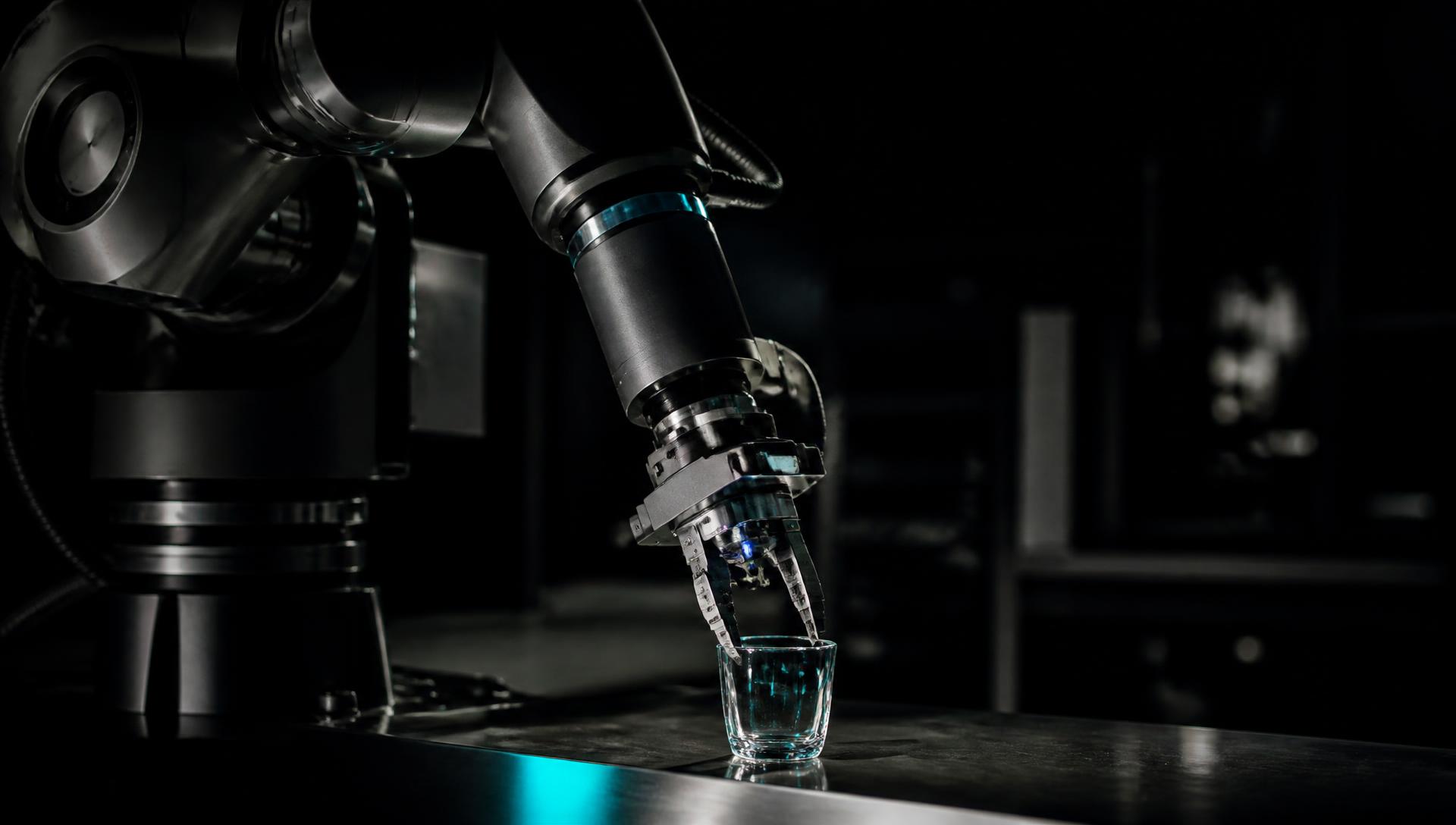
Motion is not the hard part.
Knowing it happened is.
Robotic manipulation · illustrative reference, third-party hardware
Atlas // taxonomy
01 /
How machines understand what humans actually want.
nodes // human-intent → planning
02 /
How intelligence perceives and reasons inside physical environments.
nodes // perception → world-understanding
03 /
How machines physically interact with objects.
nodes // physical-execution
04 /
How intelligent systems represent and predict physical environments.
nodes // world-understanding → planning
05 /
How machines complete tasks spanning many steps, changing state and time.
nodes // planning → orchestration → failure-recovery
06 /
How machines move humans, objects and themselves through physical space.
nodes // physical-execution → perception
07 /
How humans and intelligent machines coordinate.
nodes // human-intent → permissions → verification
08 /
How intelligence coordinates external systems, providers, APIs, humans and machines.
nodes // orchestration → payments
09 /
What happens when physical execution does not go according to plan.
nodes // failure-recovery
10 /
How a system knows the intended physical outcome actually happened.
nodes // verification
11 /
Cost curves, deployment economics, labour substitution and complementarity, utilisation, scaling.
nodes // orchestration → learning
12 /
The infrastructure required underneath intelligence operating in the physical world.
nodes // identity → permissions → payments → orchestration → verification
Atlas // research dossiers
Seven questions, opened in order. Each dossier holds its research areas, its Atlas nodes, its open problems and our thesis — and stays empty of findings until a primary source has been read and attributed.
Atlas // research chain
The dossiers are not isolated articles. Each one inherits the failure of the stage before it.
Atlas // latest signals
Signal queue // status: reading
No research note is published until its primary sources have been read and attributed. The Atlas structure, taxonomy, map and open-problem layer are live; notes enter the index one verified source at a time.
Source first. Claim second. Interpretation third.
Source hierarchy
Institutions appear as research sources only. Never as partners.
Research maturity system
Insufficient evidence // status: unverified
Atlas // unsolved
Most technology pages celebrate progress. The Atlas maps failure. Each item below is an open problem, not a product claim, and none of them are presented as solved.
Open problem
INTENT
human-intent
Open problem
PERCEPTION
perception
Open problem
PLANNING
planning → world-understanding
Open problem
DEXTERITY
physical-execution
Open problem
NAVIGATION
physical-execution → perception
Open problem
IDENTITY
identity
Open problem
PAYMENTS
payments → permissions
Open problem
PAYMENTS
payments → orchestration
Open problem
PERMISSIONS
permissions
Research note // 001
Identity, delegated authority, agent payments, permissions and verified real-world execution.
Read the research note →Research note // 002
Physical compute, real-world scheduling and the missing layer between human intent and the physical world.
Read the research note →Research note // 003
Failure recovery, replanning, closed-loop execution, executor substitution and verified outcomes in Physical AI.
Read the research note →Atlas // thesis
The execution gap
We do not claim these layers are solved. We are mapping them, and building inside them.
This is where we are looking.

Autonomy moves matter.
Infrastructure decides whether it counts.
Autonomous mobility · illustrative reference, third-party hardware
Every breakthrough changes what machines can do.
Every new capability creates new infrastructure requirements.
We are mapping that transition.
Atlas // origin
We operate in the real world.
That means we care less about what AI can demonstrate and more about what intelligence can reliably cause to happen.
Real World Atlas is our attempt to understand the systems, breakthroughs and unsolved problems shaping the transition from digital intelligence to physical agency.
We study the frontier because we are building toward it.
Built quietly in Milan
Intent to Real World
/ Research
We should probably talk.
Continue // technical record
// Milan, Italy
// Real World Atlas
// Observation continues